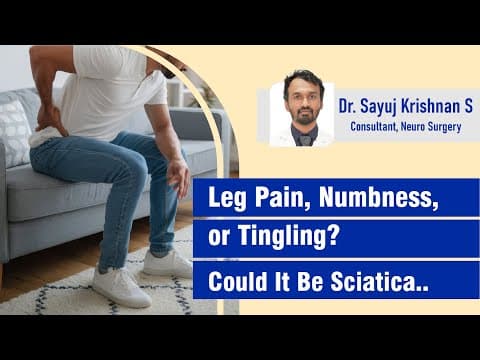
Sciatica Patient Education - Understanding Your Condition
Comprehensive patient education about sciatica symptoms, causes, and treatment options. Learn about conservative management and when surgery may be recommended.
Get relief from shooting leg pain with Dr. Sayuj Krishnan's "Conservative-First" protocol. We successfully treat 90% of sciatica patients without surgery using targeted nerve blocks and advanced physiotherapy.
Many patients are told they need surgery too soon. At our Hyderabad clinic, we believe in exhausting all non-invasive options first.
We don't just treat "pain". We identify the exact nerve root (L4, L5, or S1) causing your symptoms using MRI and clinical correlation.
A powerful anti-inflammatory injection placed precisely around the irritated nerve. This often provides immediate relief and prevents the need for surgery.
Once the pain is managed, we strengthen your core to prevent recurrence.
*Surgery is reserved for cases with severe weakness or loss of bladder/bowel control.
Sciatica is a distinct type of pain affecting the sciatic nerve, the large nerve extending from the lower back down the back of each leg. It is often described as a sharp, burning, or electric shock-like sensation.
Age is often a concern when considering spine surgery. However, traditional open surgery risks (like blood loss and long anesthesia times) are minimized with our endoscopic approach.
For patients over 60 suffering from severe back pain or sciatica, we use a specialized "Awake" or "Twilight" sedation protocol. This avoids general anesthesia and allows the patient to communicate with Dr. Sayuj during the procedure, ensuring safety.
Have you been advised open surgery? Get a second opinion to see if Endoscopic Spine Surgery is a safer option for you or your elderly parent.
Get a Second OpinionNavigating severe sciatica can be confusing. We follow an evidence-based, step-wise pathway. Surgery is never the first option, but we recognize its profound value when conservative measures are exhausted.
We halt the inflammatory cascade. This involves high-resolution MRI correlation to guarantee the diagnosis is accurate, coupled with neuropathic medications and targeted pelvic control physiotherapy to offload the compressed nerve.
Success Rate: ~70% of PatientsIf pain persists despite rest and physical therapy, we escalate to a Transforaminal Epidural Steroid Injection (TFESI). Under precise live C-arm guidance, anti-inflammatory medication is bathed directly over the swollen nerve root.
Success Rate: ~20% of Remaining PatientsWhen the compressive lesion (herniated disc) is too large to resorb naturally, or if there is impending nerve damage, we proceed to surgery.
Unlike traditional open laminectomy which requires extensive muscle detachment, Dr. Sayuj utilizes a precision 8mm endoscope. We enter through the natural foraminal window (from the side) or a microscopic interlaminar approach.
Transparent pricing for self-pay patients. Insurance packages available.
| Procedure | Estimated Cost Range (INR) | Typical Recovery | Includes |
|---|---|---|---|
| Conservative Management | ₹5,000 - ₹15,000 | 2-4 Weeks |
|
| Nerve Root Block (Injection) | ₹20,000 - ₹35,000 | Same Day Discharge |
|
| Endoscopic Discectomy | ₹1.50 Lakh - ₹2.50 Lakh | 1-2 Weeks |
|
Note: Estimates for general guidance. Final cost depends on hospital category (Economy/Private/Deluxe), specific implants (if any), and medical complexity. Insurance cashless facility available.
Most sciatica is caused by a herniated disc. Learn more about our specialized minimally invasive treatment for slip discs.
Do not ignore sciatica if you have:
These could be signs of Cauda Equina Syndrome, a medical emergency requiring immediate surgery.
While movement is key to recovery, the wrong exercises can make your pain worse. Avoid these common mistakes until cleared by Dr. Sayuj or your physiotherapist.
Why Avoid: Bending forward increases pressure on the lumbar discs by up to 100%, potentially worsening a herniated disc.
Why Avoid: Lifting both legs while lying on your back puts massive strain on your core and lower back muscles, which can aggravate sciatica.
Why Avoid: Running, jumping, or high-intensity aerobics cause repeated impact on the spine, compressing the discs further.
Why Avoid: Stretching the hamstrings too aggressively can pull on the sciatic nerve (neural tension), increasing pain and inflammation.
Learn effective home remedies and exercises to reduce nerve pain while waiting for your appointment.
Understand how minimally invasive surgery can permanently relieve sciatica when medicines fail.
Simple desk exercises to relieve back pain and prevent sciatica for IT professionals in Hyderabad.
Don't make it worse! Learn which common gym exercises can aggravate your sciatic nerve pain.
Living with sciatica can be debilitating. Get a proper diagnosis and start your journey to a pain-free life today.
Rest & medication. Apply ice/heat. Gentle walking as tolerated.
Start gentle nerve glides. Pain should reduce by 50%. If not, consider injection therapy.
Active physiotherapy. Core strengthening. Return to desk work.
Full activity. If pain persists >6 weeks, endoscopic surgery may be discussed.
Sciatica is not a condition itself, but a symptom of an underlying problem. It refers to pain that radiates along the path of the sciatic nerve, which branches from your lower back through your hips and buttocks and down each leg.
Yes. In fact, 90% of our patients recover completely with non-surgical methods like targeted nerve blocks, medication, and specialized physiotherapy. Surgery is a last resort, not the first step.
The most common cause is a herniated (slipped) disc compressing the nerve root. Other causes include spinal stenosis (narrowing of the spine), bone spurs, or rarely, a tumor or diabetic neuropathy.
No. 80-90% of sciatica cases resolve with conservative treatments like medication, physiotherapy, and rest. Surgery (endoscopic discectomy) is only recommended if pain persists after 6 weeks or if there is severe weakness.
Diagnosis starts with a physical exam to check muscle strength and reflexes (Straight Leg Raise test). An MRI scan is the gold standard to visualize the nerve compression and identify the exact cause.
Seek immediate medical attention if you experience: sudden severe pain after an accident, loss of bowel/bladder control (Cauda Equina Syndrome), or progressive weakness/numbness in the leg.
The cost depends on the procedure. A simple nerve root block may cost ₹15,000–₹25,000, while endoscopic spine surgery typically ranges from ₹1.5 Lakhs to ₹2.5 Lakhs depending on the hospital category and implant requirements.
Prolonged sitting is a major risk factor. Poor ergonomics can increase pressure on lumbar discs by 40%, potentially triggering or worsening sciatica. We recommend ergonomic adjustments and taking breaks every 30 minutes.
True sciatica comes from the spine (nerve root compression). Piriformis syndrome is when a muscle in the buttock compresses the sciatic nerve. Dr. Sayuj uses specific clinical tests to distinguish them, as treatments differ significantly (spine decompression vs. muscle release).
Yes, up to 50% of women experience some sciatic pain during pregnancy due to the baby's weight and postural changes. We offer safe, medication-free physiotherapy protocols to manage this pain without risking the baby's health.
Driving often worsens sciatica due to the vibration and leg position. We recommend short trips, using a lumbar support cushion, and stopping every 30 minutes to stretch. If you have foot weakness (foot drop), do not drive.
Avoid heavy hamstring stretches, straight leg raises, and twisting movements like golf until cleared by a physio. These can increase nerve tension.

Find specialized treatment for your condition at a clinic near you.
Medically reviewed by Dr. Sayuj KrishnanConsultant Neurosurgeon, Yashoda Hospital MalakpetLast reviewed 19 October 2025
This information is for educational purposes only and should not replace professional medical advice. Please consult with Dr. Sayuj for personalized medical guidance.
External links are provided for transparency and do not represent sponsorships. Each source was accessed on 19 Oct 2025.
Short, evidence-based explainers curated from global centres of excellence. Learn what to expect before, during, and after your procedure.
Comprehensive patient education about sciatica symptoms, causes, and treatment options. Learn about conservative management and when surgery may be recommended.